
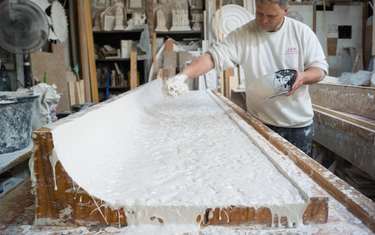
If you have ever completed work for high-end interior architecture or commercial clients, you’ve likely encountered GRG. But what exactly is it?
GRG stands for Glass-Reinforced Gypsum. By combining high-density blend (mix of alpha and beta) plasters with glass-fibre reinforcement, makers can create incredibly strong, lightweight architectural elements, from sweeping decorative columns to intricate ceiling bulkheads.
Achieving a professional-grade GRG cast requires more than just technique; it requires the right chemistry. At Industrial Plasters, we stock several high-performance options tailored for different workshop priorities.
The Best Plasters for GRG Production
Selecting your base plaster depends on your specific project needs. We have a few recommendations you can choose from, depending on whether you are prioritising cost-efficiency, strength, or speed.

For Best Value for Money:
Prestia Ceram No. 1 Plaster is a leading choice across the UK for GRG work. It is highly favoured by professionals for its price bracket and meets the needs for strength. It provides a durable, crisp finish that withstands the demands of architectural installation.
For a Quicker Set Time & Superior Strength:
When deadlines are tight, Keramicast Plaster is the widely used alternative. While it carries a slightly higher cost, it is a valuable investment for busy workshops. Its quicker setting time significantly accelerates production cycles, allowing you to demould and start the next pour much faster than with standard plasters. It also has a superior compressive strength (surface hardness) than Ceram No.1.
Reinforcement: The "Glass" in GRG
To turn these high-performance plasters into true Glass-Reinforced Gypsum, you need glass fibres designed to bond with resins, but also work well when bonded with gypsum plasters.
The Premium Choice: Unifilo U816 CFM: For the strongest possible results, we recommend Unifilo U816 CFM Fibreglass Mat. Unlike traditional chopped strand mats (CSM), this is a Continuous Filament Mat (CFM). Because the strands are continuous rather than short pieces, they offer vastly improved mechanical properties and fire resistance. It is incredibly easy to use and "wets out" into the plaster slurry quickly, ensuring a consistent and structural laminate every time.
Fibreglass Chopped Strands can be mixed into the initial face coat or slurry to reinforce tight corners and intricate details where a mat might be difficult to lay.


